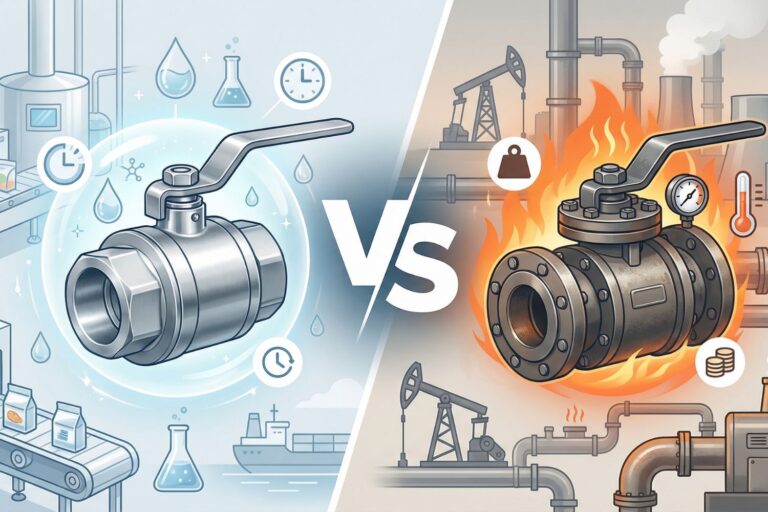
Choosing between a trunnion ball valve and a floating ball valve is one of the most consequential decisions in pipeline and process plant design. Both valves perform the same basic function — quarter-turn on/off flow control — but their internal geometry, sealing behavior, and load distribution differ significantly. Specifying the wrong type can lead to premature seat wear, excessive actuation torque, leakage under low-pressure conditions, or unnecessary capital expenditure.
This guide breaks down the engineering differences between the two designs, explains where each excels, and helps procurement teams, piping engineers, and project managers select the right valve for their application.
What Is a Floating Ball Valve?
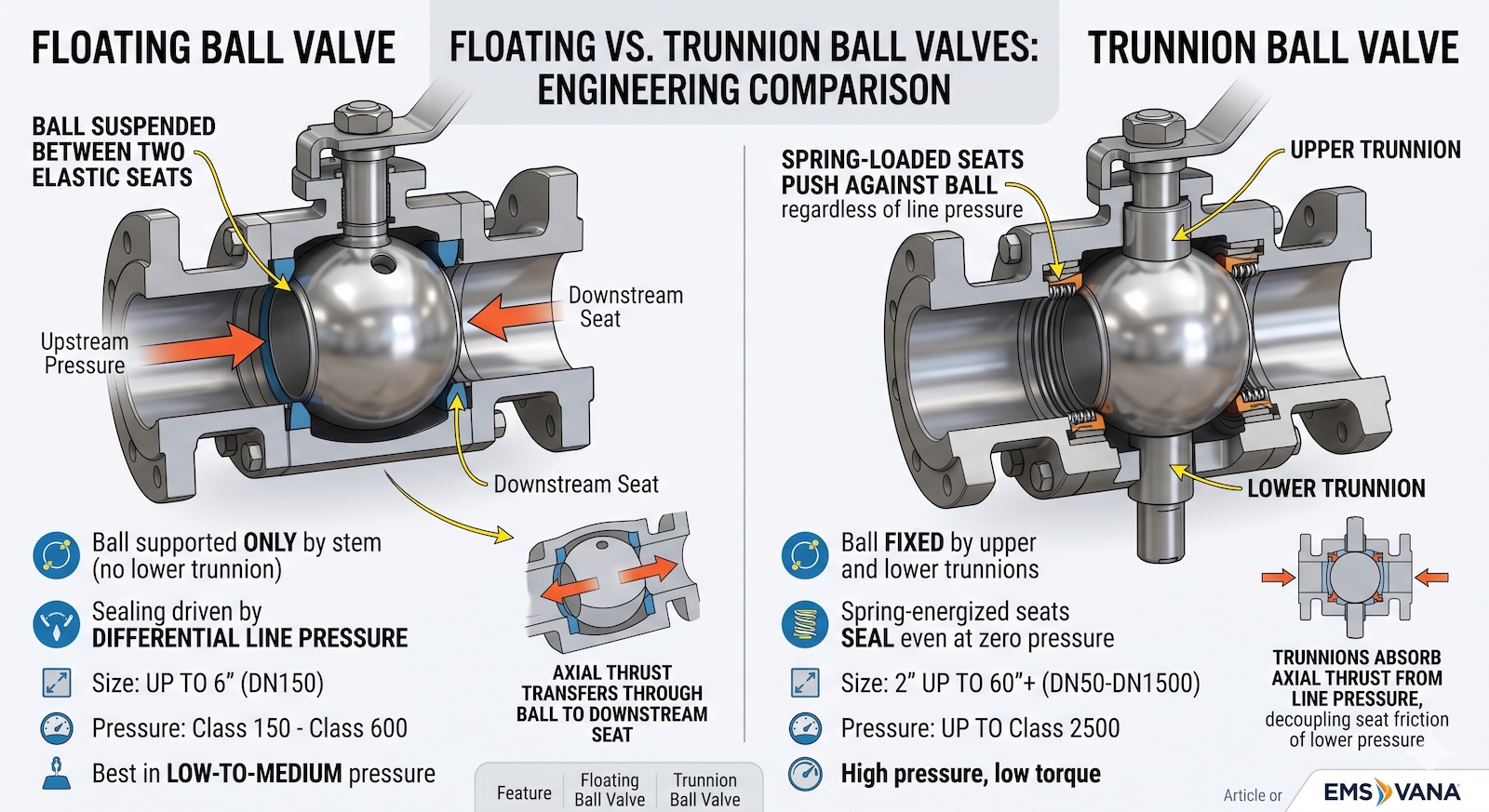
A floating ball valve is a design in which the ball is not mechanically fixed along the flow axis. Instead, it is suspended between two elastic seats and supported only by the stem at the top. When the valve is closed, upstream line pressure pushes the ball against the downstream seat, creating a tight seal.
Key characteristics:
- Ball supported only by the stem (no lower trunnion)
- Sealing driven by differential line pressure
- Typical size range: up to 6″ (DN150)
- Pressure classes: generally Class 150 to Class 600
- Common standards: ASME B16.34, API 608, ISO 17292
Because the seal depends on line pressure pushing the ball into the downstream seat, floating designs perform best in low-to-medium pressure services where the seat material can reliably absorb the axial thrust.
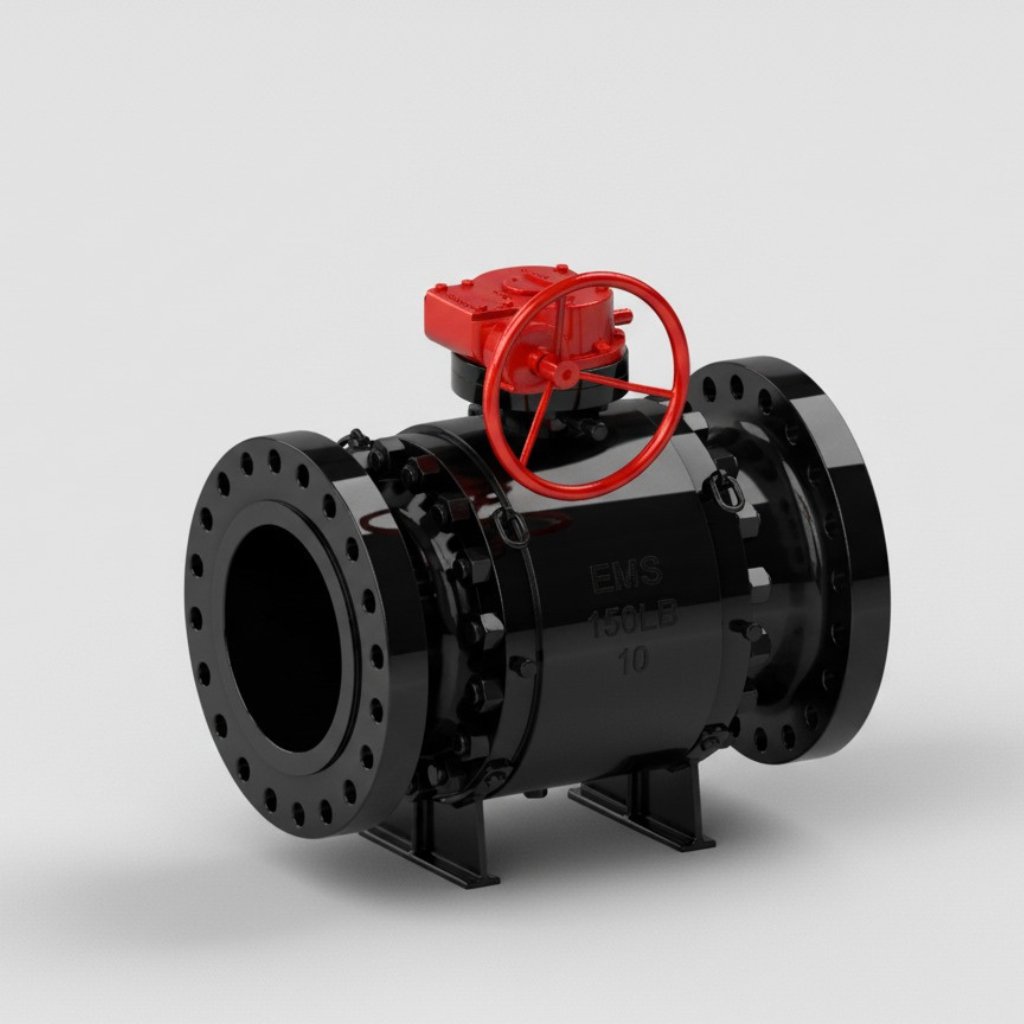
What Is a Trunnion Ball Valve?
A trunnion ball valve has the ball supported on two additional shafts — the trunnions — one at the top and one at the bottom. The ball does not translate along the flow axis; it only rotates. Sealing is achieved by spring-loaded seats that are pushed against the ball regardless of line pressure.
Key characteristics:
- Ball fixed by upper and lower trunnions
- Spring-energized seats provide sealing even at low or zero pressure
- Available in sizes from 2″ up to 60″+ (DN50–DN1500)
- Pressure classes up to Class 2500 (ANSI) or PN 420 (DIN)
- Commonly specified to API 6D for pipeline service
Because the trunnions absorb the axial thrust from line pressure, the stem and seats do not carry the ball’s full load. This allows larger diameters and higher pressures without proportionally increasing operating torque.
Trunnion vs Floating Ball Valve: Quick Comparison
| Feature | Floating Ball Valve | Trunnion Ball Valve |
|---|---|---|
| Ball support | Stem only | Top and bottom trunnions |
| Sealing mechanism | Line pressure pushes ball into seat | Spring-loaded seats press against ball |
| Typical size range | ≤ 6″ (DN150) | 2″ – 60″+ |
| Pressure range | Class 150 – 600 | Class 150 – 2500 |
| Operating torque | Rises sharply with pressure and size | Stays relatively low |
| Double Block & Bleed (DBB) | Not reliably achievable | Standard capability |
| Cavity relief | Usually self-relieving | Requires engineered relief |
| Fire-safe option | Available (API 607) | Widely available (API 607 / 6FA) |
| Relative cost | Lower | 1.5x – 3x higher |
| Typical standard | ASME B16.34, API 608 | API 6D, ASME B16.34 |
7 Key Engineering Differences Between Trunnion and Floating Ball Valves
1. Ball Support and Load Path
The most fundamental difference lies in how the ball is held. In a floating design, the entire axial force from fluid pressure transfers through the ball to the downstream seat and partially to the stem. In trunnion designs, the ball is mechanically anchored, so the seats only see the spring-energized pre-load plus the differential pressure acting on the sealing area — not the full pipeline thrust.
2. Sealing Mechanism
Floating ball valves rely on differential pressure to create a seal. At very low pressures or vacuum, sealing performance can degrade. Trunnion ball valves use pre-loaded seat springs, so they seal reliably even at near-zero upstream pressure — a critical requirement in custody transfer, pipeline isolation, and emergency shutdown (ESD) applications.
3. Size and Pressure Capability
Because thrust loads scale with bore area, a floating ball valve becomes impractical above roughly 6 inches — the downstream seat would exceed the mechanical limits of PTFE, PEEK, or similar soft materials, leading to deformation and leakage. Trunnion valves dominate large-diameter, high-pressure applications such as gas transmission pipelines, subsea service, and refinery process headers.
4. Operating Torque
In floating valves, operating torque rises sharply with pressure and diameter because the stem must overcome the friction of the ball pressed against the seat. Trunnion designs decouple the ball load from seat friction, keeping torque manageable. This directly affects actuator sizing — an undersized actuator on a large floating valve may fail to open under full line pressure, a costly failure mode in automated systems.
5. Double Block and Bleed (DBB) Capability
Trunnion ball valves with two independent spring-loaded seats can isolate a section of pipeline from both sides while allowing the body cavity to be vented — the classic double block and bleed configuration required for safe maintenance in oil and gas operations. Floating ball valves, because their sealing depends on pressure displacement of the ball, cannot reliably deliver true DBB function.
6. Cavity Relief and Thermal Expansion
When a ball valve traps fluid in its body cavity and temperature rises, pressure can spike dangerously. Floating ball valves are often self-relieving — the ball shifts slightly upstream to vent excess pressure back into the line. Trunnion valves, because the ball is fixed, require engineered cavity relief features such as self-relieving downstream seats, external relief valves, or body vent connections.
7. Cost and Lifecycle Economics
Trunnion ball valves have more components, tighter tolerances, and larger forged bodies, so initial cost is higher — typically 1.5 to 3 times the price of a floating equivalent. However, lower actuator sizing, longer service intervals, and repairable seat/seal designs mean total cost of ownership can actually be lower for critical, high-cycle services.
When to Choose a Floating Ball Valve
Floating ball valves are the right choice when:
- Line sizes are 4″ or smaller (occasionally up to 6″)
- Pressure class is 600 or below
- The service is non-critical utility — instrument air, water, nitrogen, low-pressure gas
- Budget is a primary driver and duty cycle is moderate
- A compact footprint is required
Typical applications: HVAC systems, fire protection headers, chemical dosing lines, compressed air distribution, steam sampling, and general plant utility piping.
When to Choose a Trunnion Ball Valve
Trunnion ball valves are specified when:
- Line sizes exceed 6 inches
- Pressure class is 900 or higher
- Service involves hydrocarbons, sour gas, or critical pipeline isolation
- Double block and bleed is required for safety or custody transfer
- Fire-safe or emergency shutdown performance is mandated
- Low operating torque is essential for remote, subsea, or ESD actuation
Typical applications: oil and gas transmission pipelines, refinery main process lines, LNG terminals, petrochemical reactors, offshore platforms, and gas storage facilities.
Industry Applications at a Glance
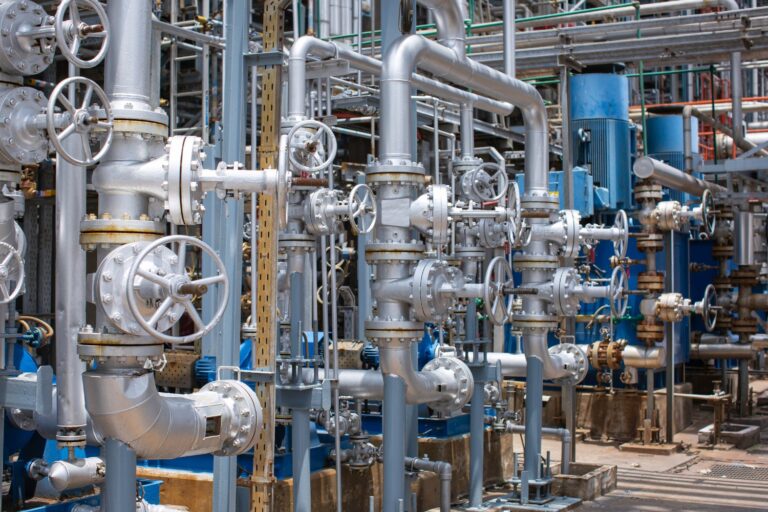
Oil & Gas Transmission — Trunnion ball valves dominate due to DBB requirements, API 6D compliance, and large diameters up to 60″ and beyond.
Refining and Petrochemical — Both designs are used. Floating valves handle auxiliary utilities and small instrument lines; trunnion valves handle process headers, reactor feed isolation, and flare systems.
Power Generation — Floating ball valves serve in boiler drains, sampling lines, and auxiliary cooling. Trunnion valves handle main steam bypass and large cooling water isolation.
Chemical Processing — Material compatibility often governs selection. Floating valves with PTFE or PFA seats handle corrosive low-pressure lines; trunnion valves handle high-pressure or high-temperature duties.
Fire Protection — Floating ball valves with UL/FM approval are standard on deluge and sprinkler risers up to 4 inches.
How to Specify the Right Ball Valve
Before issuing a purchase order, confirm these parameters with your valve manufacturer:
- Service fluid — composition, phase, contaminants, H₂S content
- Design pressure and temperature — maximum and minimum, including upset conditions
- Line size and pipe schedule
- Actuation type — manual lever, gear, pneumatic, electric, or hydraulic
- Applicable standards — API 6D, API 608, ASME B16.34, ISO 17292
- End connections — flanged RF or RTJ, butt weld, socket weld, threaded
- Fire-safe certification — API 607 or API 6FA, if required
- Special requirements — cryogenic service, NACE MR0175 sour service, low-emission to ISO 15848-1
A mismatched specification at the procurement stage is the most common root cause of field failures and costly valve replacements.
Frequently Asked Questions
Is a trunnion ball valve better than a floating ball valve?
Neither design is universally better. Trunnion ball valves perform better in large-diameter, high-pressure, and critical isolation services. Floating ball valves are more cost-effective for small-bore, lower-pressure applications. The correct choice depends on size, pressure class, sealing requirements, actuation, and duty cycle.
At what size does a floating ball valve become impractical?
Most manufacturers limit floating ball valves to 6 inches (DN150) and Class 600 ratings. Beyond this threshold, the axial thrust on the downstream seat exceeds the mechanical capacity of standard seat materials, causing deformation, premature wear, and leakage. Larger applications should use trunnion-mounted designs.
Can a floating ball valve provide double block and bleed?
No. Floating ball valves cannot reliably provide true double block and bleed function. Because the ball must translate under pressure to seal, both seats cannot independently isolate the body cavity. True DBB service requires a trunnion ball valve with two spring-loaded seats and a cavity vent connection.
Why do trunnion ball valves need cavity relief?
The ball in a trunnion valve is fixed between two seats, which can trap fluid in the body cavity when the valve is closed. If temperature rises, the trapped fluid expands and can generate pressure spikes that damage the valve. Cavity relief — through self-relieving seats or an external relief line — prevents this overpressure condition.
Which standard governs trunnion ball valves for pipelines?
API 6D (Specification for Pipeline and Piping Valves) is the governing standard for trunnion ball valves in oil and gas transmission service. It covers design, materials, testing, and marking. ASME B16.34 applies to pressure–temperature ratings, and API 607 or API 6FA cover fire-safe qualification.
Do trunnion ball valves cost more than floating ball valves?
Yes. Trunnion ball valves typically cost 1.5 to 3 times more than floating equivalents of the same nominal size and pressure class, due to additional components, tighter tolerances, and larger forged bodies. For critical services, the lower lifecycle cost and safety benefits usually justify the premium.
Conclusion: Match the Valve to the Service
The trunnion vs floating ball valve decision ultimately comes down to four factors: size, pressure, sealing demands, and safety requirements. Floating designs win on cost and compactness in small-bore, low-to-medium pressure services. Trunnion designs win on scalability, sealing reliability, and safety in large-diameter, high-pressure, and critical pipeline applications.
EMS Vana manufactures both trunnion ball valves and floating ball valves to ANSI and DIN standards, with forged-steel bodies for high-integrity service. Our engineering team can help you specify the right configuration for your project — from API 6D pipeline isolation to fire-safe refinery applications — backed by 45 years of forged valve manufacturing experience in Türkiye.
Request a quote for your next project and receive a tailored recommendation from our technical team.




Contact Us Now
Reach out to our expert team today for tailored valve solutions for your projects.