
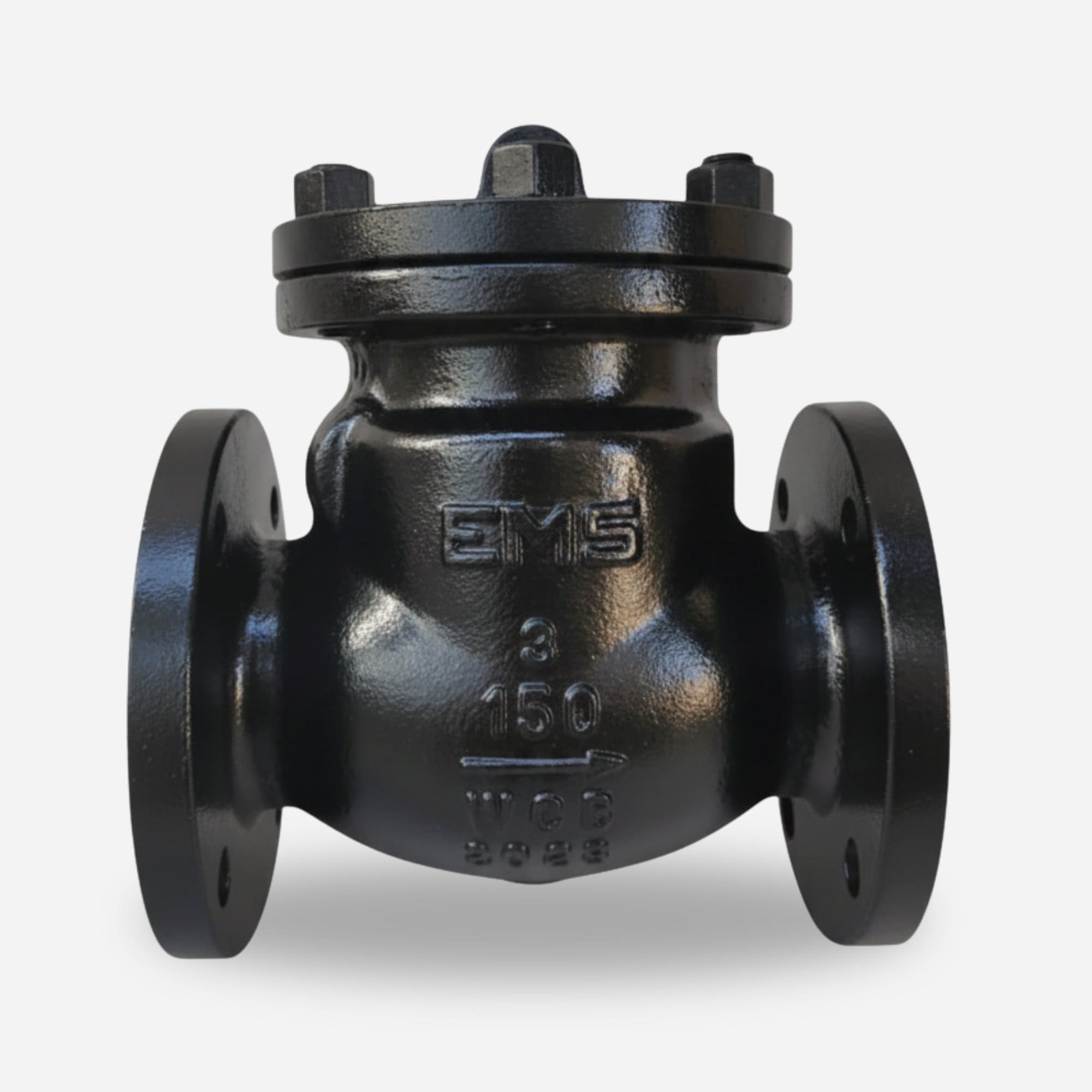
Swing Check Valve (DIN)
|
Nominal Size : |
1/2″-24″ |
|
Pressure Rating : |
PN10-PN16-PN25-PN40-PN64-PN100 |
|
Design Standards : |
EN 12516 |
|
Actuation : |
Lever operated |
|
End Connections : |
Bw, Flanged-Rf/RTJ |
|
Materials : |
ASTM A105&A216-WCB&A352-CF8&A352-CF8M&A352-CF3&A352-CF3M |
In industrial pipelines, the Swing Check Valve (DIN) reliably prevents reverse flow while offering low pressure drop, quiet operation and long service life. With a design fully compliant with EN/DIN standards and a wide range of materials, it delivers high reliability in water, steam and process media.
40+ Years of Experience
We have been operating in the sector since 1979.
Manufacturer’s Guarantee
Fast delivery and competitive pricing with our guarantee.
High Quality
We ensure high-quality production to international standards.
What Is a Swing Check Valve (DIN)? Operating Principle
Also referred to as a DIN swing check valve, this design operates on the principle of a disc that swings freely open in the direction of flow and swings back onto the seat to close the line when reverse flow starts. This simple yet robust mechanism, combined with low turbulence and a large flow cross-section, supports energy-efficient operation. Metal or soft seat options provide leak-tight performance under various temperature and chemical conditions and help minimize backflow.
DIN/EN Standard Compliance and Testing
Our Swing Check Valve configurations are typically compliant with the following standards:
- EN 1092-1: Flanged connections (PN10/16/25/40)
- EN 558 (former DIN 3202): Face-to-face dimensions
- EN 12266-1: Leakage (tightness) testing
- EN 12334: General requirements for industrial check valves
- EN 10204 3.1: Material certificates and traceability
This comprehensive compliance translates into dimensional accuracy, reliable tightness and easy interchangeability in the field.
Typical Applications
Heating and cooling (HVAC) systems, water treatment and wastewater lines, fire protection networks, power plants, general process lines (chemical, food & beverage), mining and seawater applications. Thanks to a broad size range and multiple material options, the valve can be used safely in both low-temperature and high-temperature services.
Performance and Design Advantages
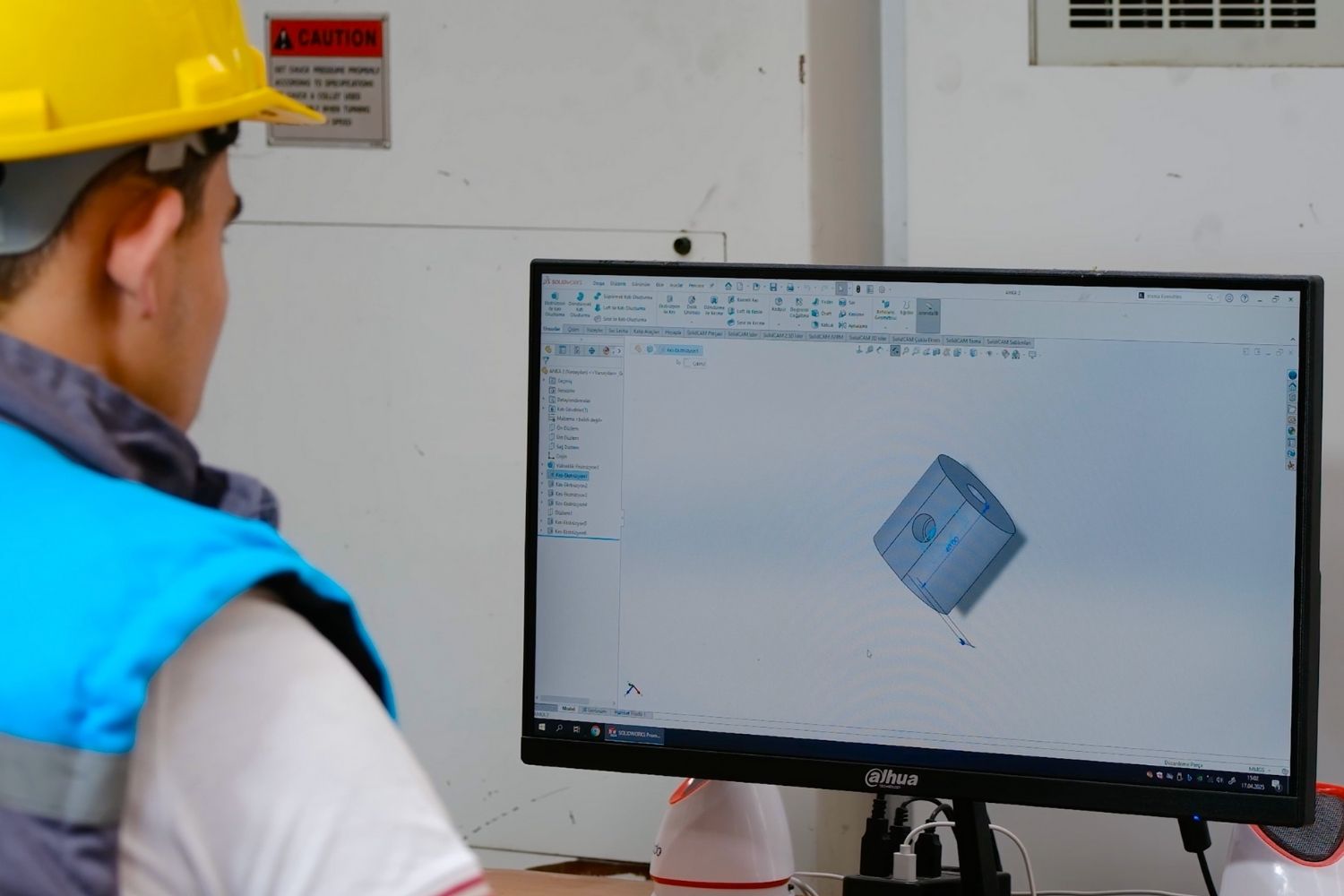
The swing mechanism, together with a full-bore body design, helps reduce pump energy consumption by offering low pressure losses. Guided disc movement ensures quiet and stable closure. Even in larger sizes, the relatively light body design and easy access to internals shorten maintenance shutdowns. By selecting suitable elastomer/metal combinations, chemical and thermal resistance can be optimized for the specific process.
Sizing Guide and Pressure Drop
Correct selection of a Swing Check Valve (DIN) must be based on flow rate, line size, fluid viscosity/density and operating pressure–temperature conditions. Oversizing may cause unstable disc movement at low velocities; undersizing can lead to unnecessary ΔP increase and premature wear. Using the manufacturer’s Kv/Cv data to calculate line velocity and pressure losses significantly improves sizing accuracy.
Swing Check Valve (DIN) Price
The price of a Swing Check Valve (DIN) depends on DN/PN rating, body and disc material, seat type, bonnet design, coating/painting requirements, testing and certification scope (e.g. 3.1 certificate, 3.2 witness/inspection) and delivery time. Sharing the fluid characteristics, temperature/pressure range and connection standard is sufficient to increase quotation accuracy.
Quotation and Engineering Support
Our team supports you with correctly sized, EN/DIN-compliant and energy-efficient Swing Check Valve (DIN) solutions from selection through commissioning. Share your project drawings and process data; we will accelerate the process with quick technical validation and a competitive quotation. Get in touch now so we can design the safest and most efficient solution for your line together.
Contact Form
Contact Us Now
Reach out to our expert team today for tailored valve solutions for your projects.